


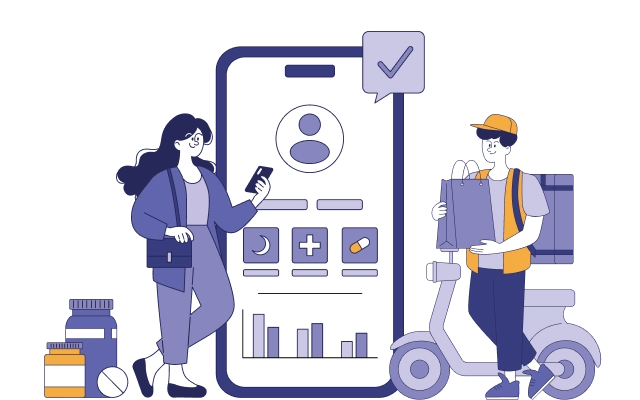
Buying medicines no longer has to mean visiting a pharmacy, waiting in line, or searching multiple stores for a specific product. With smartphones and online ordering, customers can search for medicines, upload prescriptions, place orders, make payments, and track deliveries from one app.
For businesses, this shift creates an opportunity to build digital pharmacy services around convenience and repeat purchases. An on demand medicine delivery app can connect customers with pharmacies and delivery partners while giving business owners tools to manage products, orders, payments, prescriptions, and customers from one platform.
However, entering the medicine delivery market is different from launching a standard eCommerce app. Businesses need to consider pharmacy licensing, prescription handling, medicine storage, delivery rules, data privacy, and app-store requirements. The FDA, for example, warns consumers about unsafe online pharmacies and recommends using properly licensed pharmacies.
So, is online medicine delivery app development worth the investment? The answer depends on your business model, target market, operational setup, and ability to build a safe and reliable service.
Let's look at the business opportunity, features, revenue models, development process, challenges, and factors that can affect your return on investment.
Key Takeaways
- Online medicine apps make ordering medicines more convenient.
- Customers can order medicines, upload prescriptions, and track deliveries.
- Businesses can earn through delivery fees, commissions, subscriptions, and other models.
- Prescription and pharmacy verification should be built into the platform.
- Strong security is important because the app may handle health and payment data.
- Local pharmacy and medicine regulations should be checked before launch.
- A scalable app can support pharmacies, customers, delivery partners, and administrators.
- The investment can make sense when the business has a clear market and reliable pharmacy and delivery operations.
Have a Medicine Delivery App Idea?
From customer ordering to pharmacy management and delivery tracking, build a complete solution tailored to your business needs.

Why Invest in Online Medicine Delivery App Development?
The online pharmacy model combines healthcare access with digital convenience. Customers can browse available products without visiting multiple stores and receive eligible medicines at their chosen location.
For business owners, an app can also create a direct digital channel for customer relationships.
1. Growing Demand for Digital Pharmacy Services
Customers are increasingly comfortable using mobile apps for shopping and services. Medicine ordering can fit into the same digital behavior, especially for repeat purchases and long-term medication needs.
A well-designed app can help customers:
- Search for medicines
- Check product details
- Upload prescriptions
- Compare available products
- Place orders
- Choose delivery slots
- Track deliveries
- View order history
- Reorder products
The goal is not simply to put a pharmacy catalog online. The platform should make the complete ordering process simple and reliable.
2. Repeat Purchases Can Support Revenue
Medicine and healthcare products can create repeat buying opportunities.
For example, customers may regularly purchase:
- Prescription medicines
- Over-the-counter products
- Vitamins and supplements
- Personal care products
- Medical devices
- Wellness products
Businesses can use reorder reminders, saved addresses, order history, and subscription options where legally and operationally appropriate.
3. Wider Customer Reach
A physical pharmacy mainly serves people within a specific area. A digital platform can potentially serve a larger geographic market, depending on local regulations, pharmacy partnerships, and delivery capabilities.
This allows businesses to work with multiple pharmacies or build their own pharmacy network.
Key Features of Online Medicine Delivery App Development
A medicine delivery platform normally needs separate interfaces for customers, pharmacies, delivery partners, and administrators.
Customer App Features
The customer-facing application should focus on simple ordering and clear information.
Important features include:
- User registration and login
- Medicine search
- Categories and filters
- Product details
- Prescription upload
- Cart and checkout
- Multiple payment options
- Delivery address management
- Order tracking
- Order history
- Reorder option
- Push notifications
- Customer support
- Ratings and feedback
Prescription handling deserves special attention. The workflow should make it clear when a prescription is required and how it will be reviewed.
Pharmacy Panel
Pharmacies need their own dashboard to manage daily operations.
Key functions can include:
- Product management
- Inventory updates
- Prescription review
- Order management
- Price management
- Stock alerts
- Order acceptance or rejection
- Sales reports
- Earnings tracking
This helps reduce manual work and gives pharmacies better visibility into incoming orders.
Delivery Partner App
Delivery partners can use a dedicated application to manage assigned orders.
Useful features include:
- Delivery partner registration
- Profile verification
- Order assignment
- Pickup details
- Customer location
- Navigation
- Delivery status updates
- Proof of delivery
- Earnings tracking
- Delivery history
Real-time tracking can also help customers know when their order is expected to arrive.
Admin Panel
The admin panel acts as the central control system.
It can include:
- Customer management
- Pharmacy management
- Delivery partner management
- Product management
- Prescription management
- Order monitoring
- Payment management
- Commission settings
- Coupon management
- Reports and analytics
- Notifications
- Support management
A centralized dashboard can help business owners monitor operations without switching between multiple systems.
How to Develop a Medicine Delivery App for Your Business
Building a medicine delivery platform requires more than mobile app development. You need to plan the business model, pharmacy operations, technology, compliance requirements, and delivery process together.
If you want to explore the development process in more detail, read this guide on How to Develop a Medicine Delivery app.
Step 1: Define Your Business Model
First, decide how the platform will operate.
You could build:
- A single-pharmacy app
- A multi-pharmacy marketplace
- A pharmacy delivery platform
- A medicine and healthcare marketplace
- A local medicine delivery service
The choice will affect the features, technology, integrations, and operating costs.
Step 2: Identify Your Target Customers
Define who will use the platform.
Your target audience could include:
- Families
- Senior customers
- Patients with regular prescriptions
- Caregivers
- Working professionals
- Local pharmacy customers
- Healthcare consumers
Understanding the audience helps determine which features should receive priority.
Step 3: Plan Pharmacy and Prescription Workflows
Medicine delivery needs clear processes for prescription-based products.
The system should define:
- How customers submit prescriptions
- Who reviews them
- How prescriptions are approved
- How pharmacies verify availability
- How orders are prepared
- How delivery is assigned
- How the customer receives the order
Local laws and pharmacy requirements should be reviewed before launching these workflows.
The FDA notes that legitimate online pharmacies should follow applicable licensing requirements and that consumers should be cautious of websites that sell prescription medicines without appropriate safeguards.
Step 4: Design the User Experience
Medicine ordering should not feel complicated.
Keep the main journey simple:
Search → Select → Upload Prescription if required → Checkout → Track → Receive
Use clear product information, readable text, visible pricing, and simple navigation.
Step 5: Build the Platform
The development team can then build the required mobile apps, web panels, backend, database, APIs, and integrations.
Depending on the business model, integrations may include:
- Payment gateways
- Maps and location services
- Push notifications
- SMS or email
- Prescription verification
- Pharmacy systems
- Analytics
- Customer support tools
Step 6: Test Before Launch
Testing should cover both technical and operational workflows.
Important areas include:
- Login and registration
- Medicine search
- Prescription upload
- Checkout
- Payment
- Order assignment
- Delivery tracking
- Notifications
- Inventory updates
- Admin controls
- Data security
The app should also be reviewed against the requirements of the platforms where it will be published. For Android apps, businesses can check the Google Play Health Content and Services Policy to understand the requirements that may apply to health and medical applications.
How Can a Medicine Delivery App Make Money?
A medicine delivery platform can use one or more revenue streams.
1. Commission on Orders
The platform can charge pharmacies a commission on eligible orders.
This works well for a marketplace model where multiple pharmacies receive orders through the platform.
2. Delivery Fees
Customers can pay a delivery fee based on distance, delivery speed, location, or order value.
3. Subscription Plans
A business can offer subscription plans with benefits such as:
- Free delivery
- Priority delivery
- Special offers
- Reorder reminders
- Member-only benefits
The exact offering should match local regulations and business requirements.
4. Pharmacy Subscription
Pharmacies may pay a monthly or annual fee to access the platform.
This can create recurring B2B revenue.
5. Featured Listings
Pharmacies or eligible healthcare product sellers may pay for greater visibility within the marketplace, subject to applicable advertising and healthcare rules.
A combination of revenue streams can reduce dependence on a single source of income.
What Makes a Medicine Delivery App Successful?
Technology alone does not guarantee business success. Several operational factors matter.
Easy Ordering
Customers should be able to find and order products quickly.
Reliable Inventory
Showing unavailable medicines as available can create customer frustration. Inventory data should be updated as frequently as possible.
Fast and Safe Delivery
Medicine delivery needs reliable handling and suitable storage conditions where required.
The World Health Organization warns that medicines from unauthorized online sources may have unknown origins or storage conditions, which makes supply-chain controls important.
Clear Prescription Process
Customers should know which products require prescriptions and what information they need to provide.
Customer Support
Customers may have questions about order status, prescription approval, refunds, or delivery issues. Easy access to support can improve the overall experience.
Security and Compliance Considerations
Healthcare apps can handle sensitive personal and health information, so privacy and security should be considered from the beginning.
Important areas include:
- Secure authentication
- Data encryption
- Role-based access
- Secure payment processing
- Prescription data protection
- Audit logs
- Secure APIs
- Privacy policies
- Data retention controls
Businesses should also understand the risks related to unsafe or falsified medicines. The WHO guidance on Substandard and Falsified Medical Products explains the risks associated with medical products that do not meet quality standards.
App stores also have specific requirements for health and medical applications. Google Play requires health and medical apps to follow applicable laws and regulations, complete its health-app declaration process where applicable, and provide a privacy policy covering sensitive data handling.
Apple also highlights additional privacy considerations for health, fitness, and medical data.
Therefore, compliance should not be treated as something to handle after development. It should be part of the product plan.
How Much Does It Cost to Build a Medicine Delivery App?
There is no single development price for every medicine delivery application.
The final cost can depend on:
- Number of apps
- Number of user roles
- UI/UX complexity
- Custom features
- Prescription workflows
- Pharmacy integrations
- Payment integrations
- Delivery tracking
- Admin panel
- Third-party APIs
- Security requirements
- Development location
- Maintenance requirements
A basic single-pharmacy application will generally require fewer components than a multi-pharmacy marketplace with customer, pharmacy, delivery, and admin applications.
For a better estimate, businesses should first prepare a feature list and define the target market. The development team can then estimate the work based on the actual scope.
Challenges to Consider Before Investing
Online medicine delivery can offer business opportunities, but it also comes with challenges.
Regulatory Requirements
Medicine sales and delivery can be regulated differently across countries and regions. Businesses need to understand the rules that apply to their target market.
Prescription Management
Prescription medicines require stronger controls than normal eCommerce products.
Inventory Accuracy
Pharmacies need reliable inventory processes to reduce cancelled or delayed orders.
Delivery Operations
Some medicines may require special handling, storage, or delivery conditions.
Customer Trust
Customers need confidence that the pharmacy, medicine, payment process, and delivery service are reliable.
The WHO has also highlighted the risks linked to unauthorized online medicine sources and falsified or substandard medical products.
These challenges do not make the business model impossible. They show why the technology and operational model should be planned together.
Is Online Medicine Delivery App Development Worth the Investment?
For the right business model, an online medicine delivery app can create a useful digital sales and service channel.
The investment can make sense when you have:
- A clear target market
- Reliable pharmacy partnerships
- A practical delivery model
- A strong compliance plan
- A simple customer experience
- Secure technology
- A plan for repeat purchases
- Enough resources for marketing and operations
It is also important to avoid treating the app as a complete business. The technology is only one part of the operation. Pharmacy relationships, inventory, fulfillment, delivery, customer support, compliance, and marketing all influence the final results.
A phased launch can help businesses control risk. Start with the most important features, validate customer demand, improve the workflow, and then add advanced capabilities as the business grows.
Future Opportunities for Medicine Delivery Apps
Medicine delivery platforms can expand beyond basic ordering.
Potential additions include:
- AI-powered product search
- Smart reorder reminders
- Personalized product recommendations
- Voice-based search
- Automated customer support
- Delivery route optimization
- Inventory forecasting
- Pharmacy analytics
- Subscription management
- Telemedicine integrations
AI should be used carefully in healthcare-related products. Features that provide medical information or recommendations should have appropriate safeguards and should not replace qualified healthcare professionals.
Know Your App Development Cost Before You Start
Tell us what you want to build and receive a detailed estimate to plan your medicine delivery app investment with greater clarity.
Conclusion
Online medicine delivery app development can be a practical investment for businesses that have a clear market, reliable pharmacy operations, and a strong plan for compliance and delivery.
A successful platform should do more than allow customers to order medicines. It should connect customers, pharmacies, delivery partners, and administrators through one secure system.
The most important areas to focus on are simple ordering, prescription handling, accurate inventory, secure payments, reliable delivery, customer support, and regulatory compliance.
If these areas are planned properly, a medicine delivery app can become a scalable digital channel for pharmacies and healthcare businesses while giving customers a more convenient way to manage eligible medicine and healthcare purchases.
FAQs
1. What is an online medicine delivery app?
An online medicine delivery app allows customers to search for eligible medicines and healthcare products, place orders, submit prescriptions when required, make payments, and receive deliveries. Depending on the business model, the platform can also connect multiple pharmacies and delivery partners.
2. What are the main features of a medicine delivery app?
Common features include medicine search, product categories, prescription upload, cart and checkout, online payments, order tracking, delivery management, notifications, pharmacy management, inventory management, and an admin dashboard.
3. How does a medicine delivery app make money?
Common revenue models include pharmacy commissions, delivery charges, subscription plans, pharmacy fees, and eligible promotional or featured listing fees. Businesses can select one or combine several models based on their market and operating structure.
4. How long does it take to develop a medicine delivery app?
The timeline depends on the number of apps, features, integrations, design requirements, prescription workflows, and business model. A basic application can take less time than a multi-vendor platform with pharmacy, delivery, customer, and admin applications.
5. What should businesses consider before launching a medicine delivery app?
Businesses should review local pharmacy and medicine regulations, prescription requirements, data privacy, pharmacy licensing, medicine storage, inventory management, delivery operations, payment security, and app-store requirements before launching.
About Author

Sophia Green
Sophia Green is a passionate app developer and tech enthusiast with over a decade of experience in the industry. She specializes in creating innovative solutions that drive business success. When she's not coding, Sophia enjoys exploring the latest trends in technology and sharing her insights through writing. Her goal is to make complex concepts easy to understand for everyone.